Showing posts with label Science. Show all posts

Monday, 14 February 2011

T-shirt: How to explain your research at a party.

My new t-shirt reward for renewing my subscription to Science arrived. I wore it proudly yesterday.

How to explain your research at a party.

I have probably used all of these techniques at one point. Diagram, Lecture, Demonstration, Embellishment, Puppet Show, Interpretive Dance.

One might have just as easily titled this "the six stages of increasing desperation when explaining your research at a party."

Sunday, 12 September 2010

Measuring Shellpot Creek Stream Flow with a Leaf

Before today's rain, the Shellpot Creek has been so low due to the lack of rain that it has contracted down to flowing through a few inch wide cleft in the rocks on the stream bed in the middle of the picture below.

Here is the cleft:

The width is about 3.25 inches:


The depth is 2 inches, the ruler I used goes to 16 inches on the right side and 14 inches is just visible below.


I realized that such a controlled situation would allow me to measure the stream flow with a ruler and something like a leaf floating in the water to get the flow velocity of the surface. I used my camera and flip video to capture the measurements and as a timer for the flow. I repositioned the ruler and used an imaginary line drawn from the cleft in the rock to the ruler edge. This distance is 5.25 inches. I then used the flip video snapshot function to find the exact frame the leaf first crosses the imaginary line at the cleft in the rock and the exact frame the leaf just touches the ruler at the other end (leaf and red lines below).


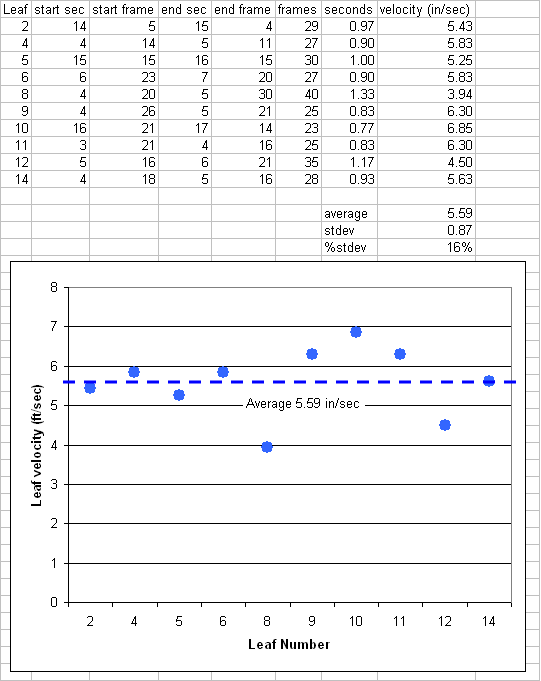
There are 30 frames/second in the video. I got 10 successful measurements from 14 leaf drops, ranging from 23 frames to 40 frames, corresponding to an average of 5.59 inches/second +/s 15% for the velocity of the leaf and thus for the velocity of the top of the water.

I pieced them all together in the following video.
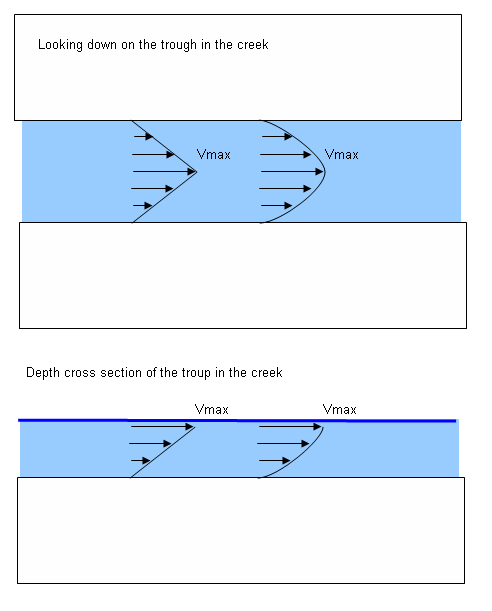


Without doing the extra work that would be required given the fluid mechanics of the situation we are going to assume that the channel is rectangular and that I have measured the maximum velocity of the fluid. That corresponds to the right hand side of the chart below.

If we assume a linear velocity profile the average velocity is 5.59 inches/sec multiplied by a 2 inch depth and a 3.25 in width to get 36.3 cubic inches/sec for the flow. In reality the velocity profile is more parabolic like the right hand side of the diagram above and the average velocity is higher. Also, the channel is not smooth on the sides or the bottom, because of pebbles and stones and even the cross section will not be regular. Close examination of the video of the leaves floating by shows that they often go fast on the right hand side of the flow of the creek and slower on the left hand side, giving another clue that the velocity profile isn't simple.

Thus I feel like I have measured more of a lower bound for the flowrate. What would my readers do differently?

Sunday, 12 July 2009

Babies and monkeys laughing at unpopular names

Sometimes the most recent good stuff is over at Childhood Antics:

A study of baby, monkey and primate laughter shows evolution of laughter seems to follow the evolution of primates.

A study of name popularity indicates a correlation between unpopular names and juvenile delinquency. Do I wish I knew that before we named our son?

Friday, 10 July 2009

Science - is there nothing it won't do?

Two comics today that perfectly capture the hubris of science and engineering.


(via Savage Chickens)

I also like the contrast between normal person and doctor or engineer, it doesn't appear that you can be both.

(via Saturday Morning Breakfast Cereal)